Methodology

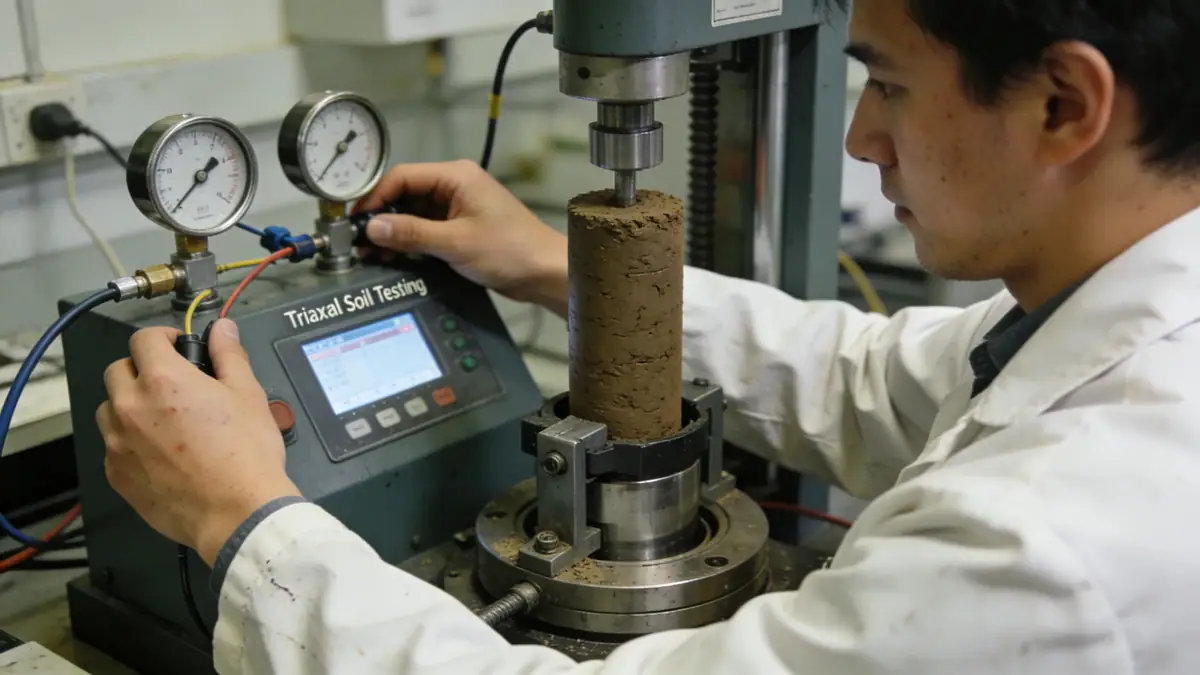
Our field investigation methodology in Whitby integrates standard penetration testing (SPT) per ASTM D1586 with continuous sampling to characterize glacial till and lacustrine clay strata. We deploy spt boring at depths ranging from 8 to 30 meters, depending on structural loads, with sampling intervals every 1.0 to 1.5 meters. Laboratory testing on recovered cores—including grain size distribution, Atterberg limits, and triaxial shear—provides engineering parameters for foundation design. Seismic hazard analysis follows the 2020 National Building Code of Canada, incorporating site-specific peak ground acceleration (PGA) values. This phased approach ensures that our recommendations address settlement, bearing capacity, and liquefaction potential, tailored to Whitby's heterogeneous subsurface conditions.
Reference Technical Parameters
| Parameter | Reference Value |
|---|---|
| Predominant soil type | Glacial till over lacustrine clay and silt |
| Maximum seismic acceleration (PGA) | 0.15g to 0.25g (NBCC 2020 Site Class D) |
| Typical groundwater level | 1.5 to 6.0 m below grade |
| Bedrock depth | Variable; 20 to 60 m (shale/limestone) |
| Typical N60 range | 4 to 30 blows/0.3 m (clay to dense till) |
Local Considerations — Whitby
Whitby's geology is dominated by Pleistocene glacial deposits overlying Ordovician shale and limestone. The southern areas near Lake Ontario feature soft to firm clayey silt with groundwater as shallow as 1.5 m, requiring dewatering and foundation drainage. Northern developments encounter dense till with higher bearing capacity. Seismic site classification per NBCC 2020 typically falls under Site Class D or E, with PGA values up to 0.25g. Local municipalities enforce Ontario Regulation 406/19 for sewer and water infrastructure, mandating geotechnical reports. Our team coordinates with the soil mechanics laboratory to assess consolidation and shear strength, ensuring designs comply with regional standards. For projects outside Whitby, we also provide geotechnical engineering en Toronto services.
Request a Quote
Our team reviews your project and issues an initial report at no cost.
Or write us directly at [email protected]
Services in Whitby
Applicable Standards
- ASTM D1586
- ASCE 7
- Ontario Building Code (OBC) 2012
- NBCC 2020
Frequently Asked Questions
What soil types are commonly encountered in Whitby?
Whitby's subsurface primarily consists of glacial till—a mix of clay, silt, sand, and gravel—overlying lacustrine clay and silt deposits. In southern areas near Lake Ontario, soft to firm clayey silt is common, while northern regions feature denser till with higher bearing capacity. Bedrock (shale/limestone) lies at depths of 20–60 m.
Does Whitby have specific seismic design requirements?
Yes. Whitby falls under NBCC 2020 seismic hazard zones with PGA values of 0.15–0.25g for a 2% in 50-year probability. Site-specific analysis is required for buildings of importance category III or IV, or where soil amplification is suspected. The OBC mandates these assessments for most commercial and multi-storey structures.
Are geotechnical studies mandatory for residential projects in Whitby?
For single-family homes, geotechnical studies are not universally mandatory, but they are strongly recommended for sites with shallow groundwater, soft soils, or slopes. The Town of Whitby may require a geotechnical report for subdivisions, retaining walls over 1.5 m, or any development on former agricultural land. Consulting our firm ensures compliance and risk mitigation.