
Methodology
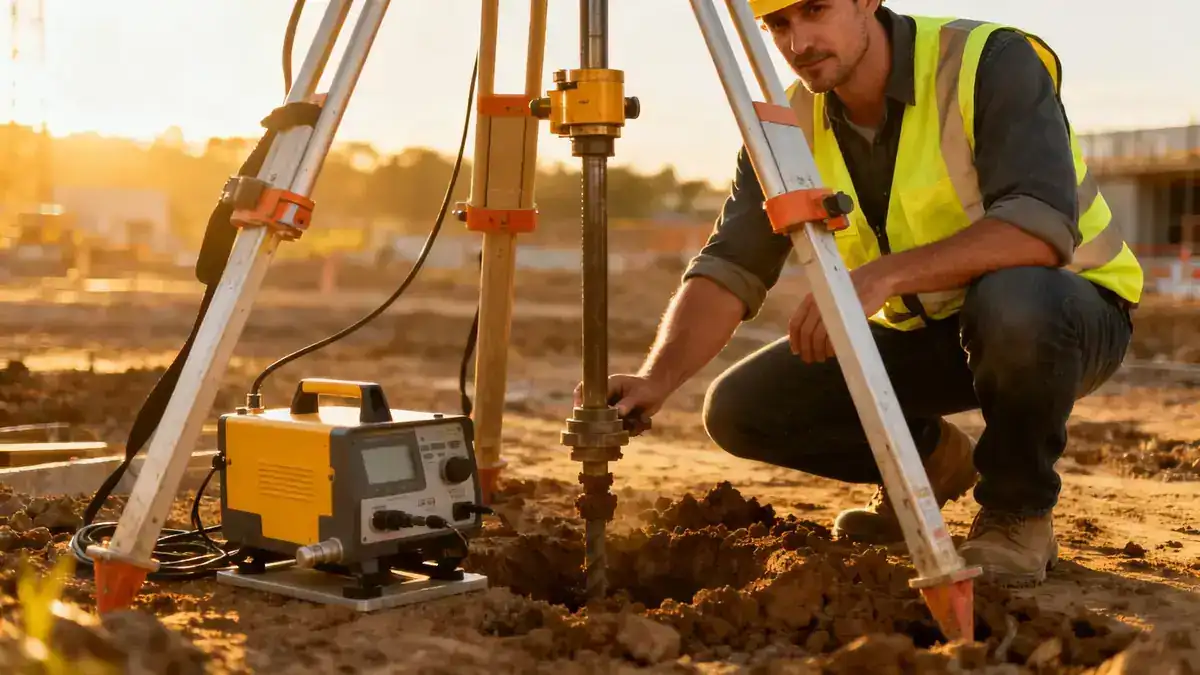
Our methodology for geotechnical engineering in Terrebonne follows a systematic process aligned with ASTM D1586 for standard penetration testing. We begin with a thorough review of existing geological maps and records, followed by field investigations including spt boring at strategic locations to characterize subsurface conditions. Samples are collected at 1.5-meter intervals and analyzed in our laboratory for index properties and strength parameters. Data interpretation incorporates local seismic hazard assessments per the National Building Code of Canada (NBCC). This integrated approach ensures that foundation designs, slope stability analyses, and earthwork recommendations are tailored to Terrebonne's specific soil profile.
Reference Technical Parameters
| Parameter | Reference Value |
|---|---|
| Predominant soil type | Marine clay and silt (Champlain Sea) |
| Maximum seismic acceleration (PGA) | 0.2g (NBCC 2020) |
| Typical groundwater level | 1–3 m below surface |
| Bedrock depth | 20–40 m (Shale and limestone) |
| Typical N60 range | 5–15 blows/300mm (clay); 20–40 blows/300mm (till) |
Local Considerations — Terrebonne
Terrebonne is underlain by marine clay and silt deposits of the Champlain Sea, with variable thicknesses of up to 30 meters. The water table is typically shallow, within 1–3 meters of the surface, requiring dewatering considerations for excavations. Seismic hazard is moderate, with a peak ground acceleration (PGA) of approximately 0.2g per NBCC 2020. The city exhibits contrasting soil conditions between older neighborhoods near the Mille-Îles River and newer developments on former agricultural land, necessitating site-specific investigations. Typical projects include residential subdivisions, commercial buildings, and infrastructure upgrades. Our soil mechanics laboratory provides essential data for these diverse settings. For larger regional projects, our team coordinates with geotechnical engineering en Montreal as the primary hub.
Request a Quote
Our team reviews your project and issues an initial report at no cost.
Or write us directly at [email protected]
Services in Terrebonne
Applicable Standards
- ASTM D1586
- National Building Code of Canada (NBCC) 2020
- CSA A23.3
- Canadian Foundation Engineering Manual (CFEM)
Frequently Asked Questions
What soil types are commonly found in Terrebonne?
Terrebonne is predominantly underlain by marine clay and silt deposits from the Champlain Sea, with glacial till and bedrock (shale and limestone) at depth. These fine-grained soils have low permeability and high compressibility, requiring careful geotechnical analysis for foundation design.
How does seismic design apply to Terrebonne?
Terrebonne falls within a moderate seismic hazard zone per NBCC 2020, with a PGA of 0.2g. Geotechnical investigations must evaluate liquefaction potential in saturated sands and dynamic soil properties for site-specific response spectra, especially for essential structures.
Are geotechnical studies mandatory for construction in Terrebonne?
Yes, the Quebec Building Code requires a geotechnical study for most building permits, particularly for structures exceeding three stories or with unusual soil conditions. Our team ensures compliance with local regulations and provides the necessary reports for permit approval.