Methodology

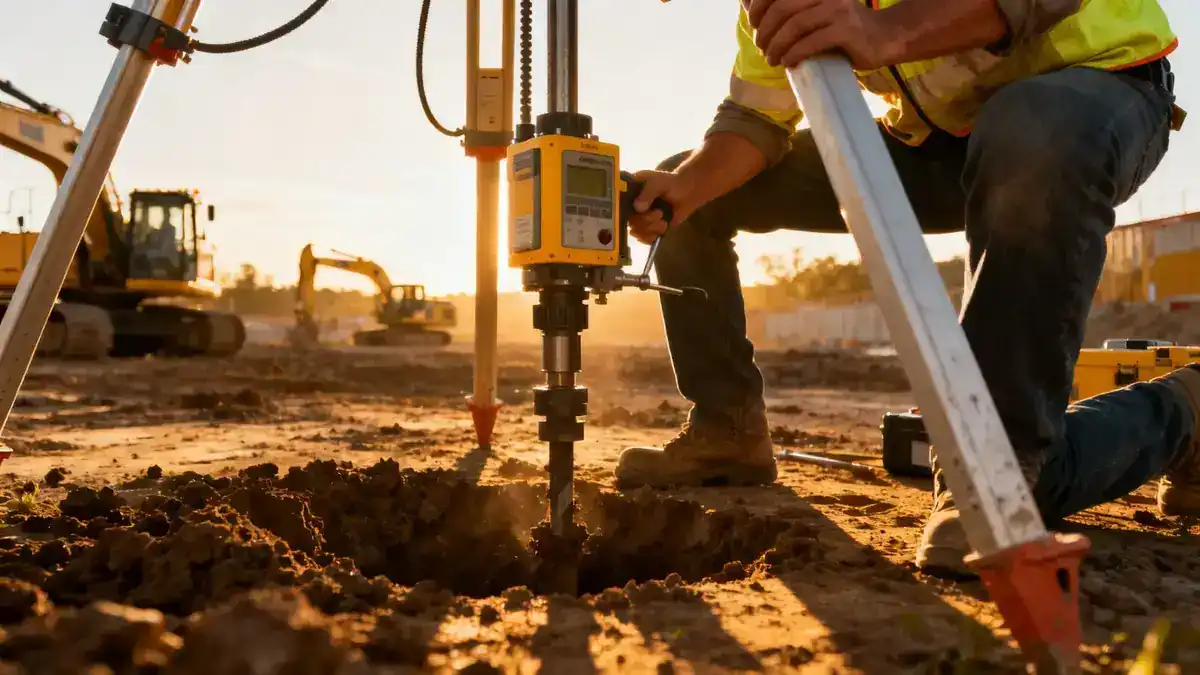
Our approach to geotechnical engineering in Saint Hyacinthe begins with a thorough review of existing geological maps and historical data. We then conduct a field investigation program tailored to the site, typically including spt boring to obtain soil samples and measure N60 values, as well as cone penetration testing (CPT) for continuous stratigraphic profiling. Laboratory work follows on representative samples to determine index properties, strength, and consolidation characteristics. All testing adheres to relevant ASTM standards, such as ASTM D1586 for SPT. By integrating field and lab data with local knowledge, our team develops a reliable geotechnical model that informs foundation design, slope stability analysis, and excavation planning for projects across Saint Hyacinthe.
Reference Technical Parameters
| Parameter | Reference Value |
|---|---|
| Predominant soil type | Clay and silty clay with occasional sand lenses (Champlain Sea deposits) |
| Maximum seismic acceleration (PGA) | 0.18 g (Site Class D, per NBCC 2020) |
| Typical groundwater level | 1.5 to 3.0 m below ground surface |
| Bedrock depth | 20 to 40 m (shallow in northern areas, deeper near river) |
| Typical N60 range | 2 to 10 blows/ft (soft clay) – variable with sand lenses |
Local Considerations — Saint Hyacinthe
Saint Hyacinthe lies within the St. Lawrence Lowlands, underlain by deep Champlain Sea clay deposits. These soft, compressible clays can lead to significant settlement if not properly addressed. The city is also in a moderate seismic zone, requiring consideration of site amplification effects per NBCC 2020. Groundwater levels are generally shallow, complicating excavation and requiring dewatering measures. Neighborhoods on the north side, closer to the Yamaska River, tend to have softer soils, while areas to the south may have stiffer glacial till. Typical projects involve lightweight residential foundations on shallow footings or pile-supported structures for heavier loads. For comprehensive regional expertise, our team builds on geotechnical engineering en Montreal experience, adapting methods to Saint Hyacinthe's specific conditions.
Request a Quote
Our team reviews your project and issues an initial report at no cost.
Or write us directly at [email protected]
Services in Saint Hyacinthe
Applicable Standards
- ASTM D1586 (Standard Test Method for SPT)
- NBCC 2020 (National Building Code of Canada – seismic provisions)
- CSA A23.1 (Concrete materials – foundation requirements)
- ASTM D2487 (Unified Soil Classification System)
- Quebec Construction Code (Chapter I, Building)
Frequently Asked Questions
What types of soil are commonly found in Saint Hyacinthe?
The predominant soils are post-glacial marine clays (Champlain Sea deposits), which are soft and compressible. Silty clay with occasional sand lenses is typical. Glacial till and bedrock are encountered at depth in some areas, especially to the north.
Does Saint Hyacinthe require seismic design for foundations?
Yes, the region is classified as a moderate seismic zone under NBCC 2020, with a PGA of 0.18 g for Site Class D. Site-specific seismic hazard analysis is often required for critical structures, and foundation designs must account for potential liquefaction in loose sand layers.
Are geotechnical studies mandatory for new construction in Saint Hyacinthe?
While not always mandatory for small residential projects, the Quebec Construction Code and local bylaws often require a geotechnical report for commercial, industrial, or multi-story buildings. Our firm recommends a study for any project involving significant loads or deep excavations to ensure safety and compliance.