
Methodology
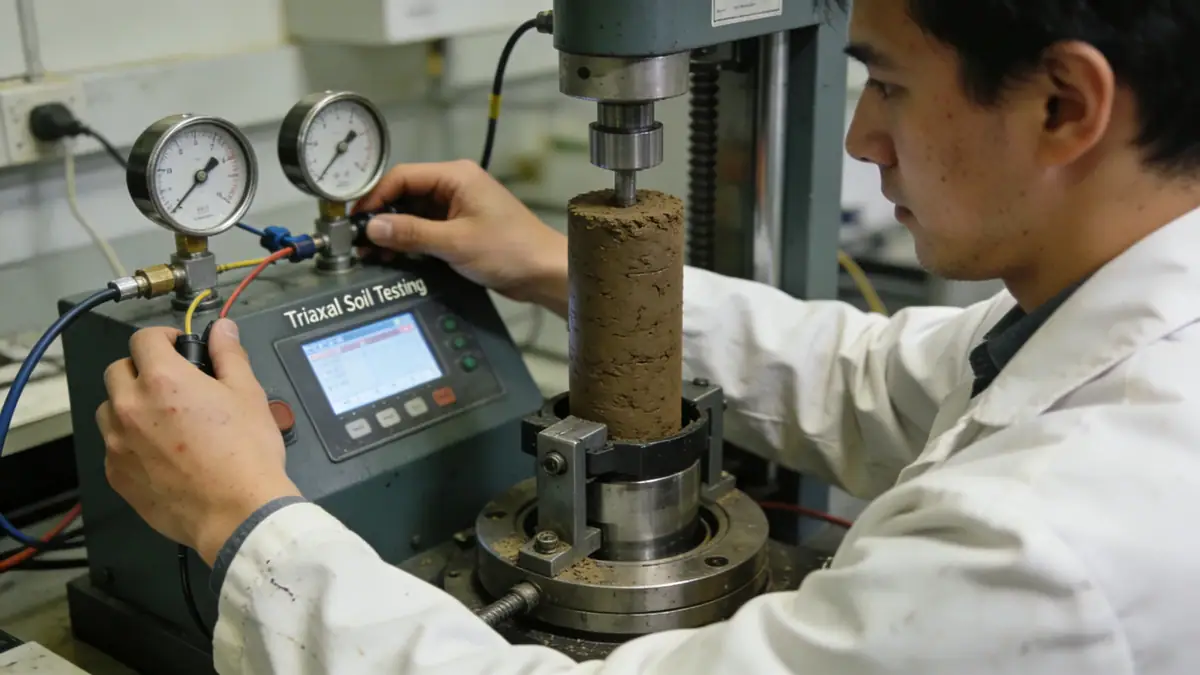
Our geotechnical engineering methodology in Prince George integrates site reconnaissance, subsurface exploration, and laboratory testing to characterize soil and groundwater conditions. We employ standard penetration testing (SPT) per ASTM D1586, supplemented by sampling for index properties and strength tests. Our approach includes spt boring to obtain disturbed and undisturbed samples, and subsequent analysis in our soil mechanics laboratory for classification, compaction, and shear strength parameters. This data informs foundation design, slope stability evaluations, and earthwork recommendations tailored to Prince George's geological context.
Reference Technical Parameters
| Parameter | Reference Value |
|---|---|
| Predominant soil type | Glaciolacustrine silty clay and sand |
| Maximum seismic acceleration (PGA) | 0.15g (NBCC 2020, Site Class C) |
| Typical groundwater level | 2–6 m below ground surface |
| Bedrock depth | 10–30 m (Cretaceous sandstone/shale) |
| Typical N60 range | 5–30 blows/0.3 m |
Local Considerations — Prince George
Prince George's subsurface conditions are heavily influenced by glacial history. The predominant glaciolacustrine clays are often soft to firm, with sensitivity to disturbance and potential for consolidation settlement under load. Seasonal groundwater fluctuations, particularly in spring, require careful consideration for excavations and foundation drainage. Seismic hazard is moderate, with a peak ground acceleration (PGA) of 0.15g per NBCC 2020, necessitating site-specific response spectra for critical structures. In older downtown areas, fill and organic soils may be encountered, requiring deeper foundations or ground improvement. Typical projects include low-rise buildings, industrial facilities, and transportation infrastructure. For broader regional context, our team draws on expertise from geotechnical engineering en Vancouver.
Request a Quote
Our team reviews your project and issues an initial report at no cost.
Or write us directly at [email protected]
Services in Prince George
Applicable Standards
- ASTM D1586
- National Building Code of Canada 2020
- BC Building Code
- ASTM D2487
- ASTM D3080
Frequently Asked Questions
What types of soil are commonly found in Prince George?
Soils in Prince George are predominantly glaciolacustrine silty clays and sands, underlain by Cretaceous sedimentary bedrock. Localized deposits of glacial till and organic soils occur in valley bottoms and former lakebeds.
What seismic design considerations apply in Prince George?
Prince George is in a moderate seismic zone with a PGA of 0.15g per NBCC 2020. Site-specific seismic hazard analysis is required for important structures, considering soil amplification potential from soft clay deposits.
Are geotechnical studies mandatory for construction in Prince George?
While not always mandatory for small residential projects, geotechnical studies are strongly recommended for any structure with significant loads, deep foundations, or in areas with variable soil conditions. The BC Building Code requires site characterization for most commercial and multi-family buildings.