
Methodology
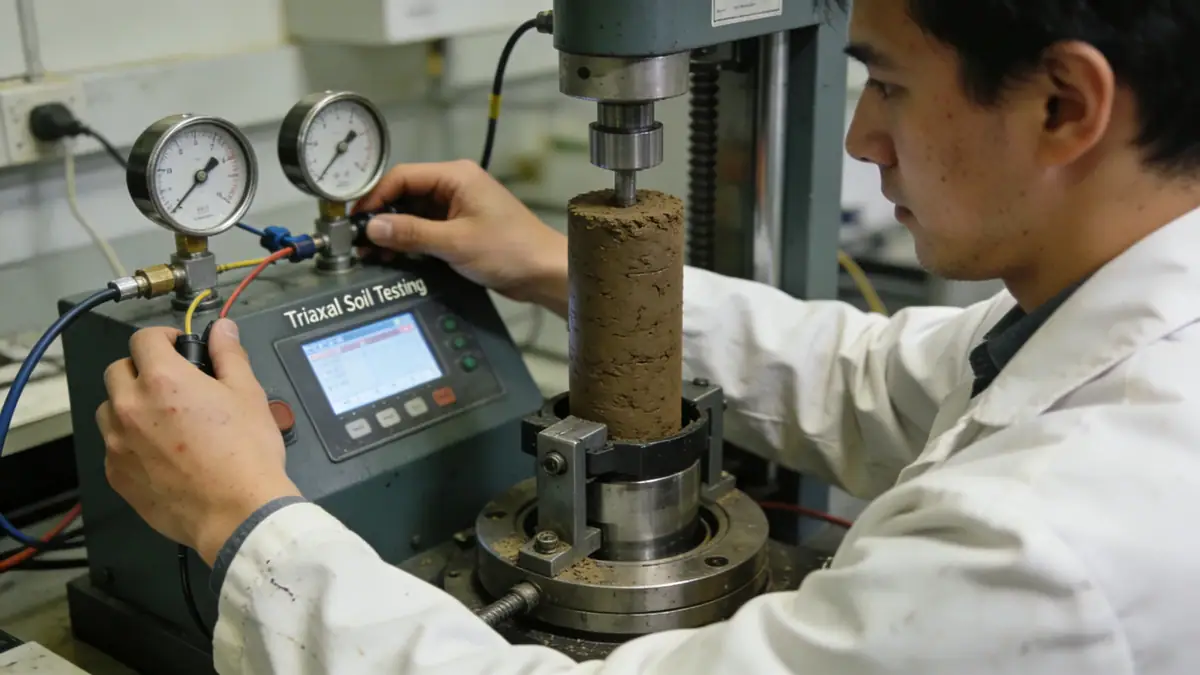
Our methodology for projects in Drummondville follows established standards, beginning with a thorough review of geological maps and historical data. We employ spt boring to characterize soil strata, utilizing ASTM D1586 for standard penetration tests at 1.0 to 1.5 m intervals. Samples are analyzed in our soil mechanics laboratory for index properties and strength parameters. This integrated approach provides a comprehensive understanding of subsurface conditions, enabling precise foundation and earthwork designs.
Reference Technical Parameters
| Parameter | Reference Value |
|---|---|
| Predominant soil type | Glacial till and marine clay |
| Maximum seismic acceleration (PGA) | 0.2–0.3 g (per NBCC 2020) |
| Typical groundwater level | 1.5–3.0 m below ground surface |
| Bedrock depth | Variable; 10–30 m depending on location |
| Typical N60 range | 4–15 blows/0.3 m (clay); 20–40 (till) |
Local Considerations — Drummondville
Drummondville's geology is shaped by the Champlain Sea, leaving sensitive marine clays that require careful handling. The region's seismic hazard, classified as moderate per NBCC 2020, necessitates site-specific response analyses. Groundwater levels are typically shallow, posing challenges for excavations and requiring dewatering plans. Our team integrates these factors into every project, referencing our slope stability expertise for embankments and excavations. For regional context, our geotechnical engineering in Montreal hub provides broader insights into similar geological settings.
Request a Quote
Our team reviews your project and issues an initial report at no cost.
Or write us directly at [email protected]
Services in Drummondville
Applicable Standards
- ASTM D1586 (Standard Penetration Test)
- ASCE 7 (Minimum Design Loads for Buildings)
- National Building Code of Canada (NBCC 2020)
- Quebec Construction Code (Chapter I, Building)
Frequently Asked Questions
What are the predominant soil types in Drummondville?
The region features glacial till and Champlain Sea marine clays. Till is dense and granular, while clays are soft to firm, sensitive, and prone to settlement. Understanding this variability is critical for foundation design.
What seismic design parameters apply in Drummondville?
Per NBCC 2020, Drummondville falls in a moderate seismic zone with a peak ground acceleration (PGA) of 0.2–0.3 g. Site-specific spectra are required for important structures, accounting for soil amplification effects.
Are geotechnical studies mandatory for construction in Drummondville?
Yes, for most commercial, industrial, and multi-residential projects. The Quebec Construction Code requires subsurface investigations to ensure safe design. Single-family homes may be exempt, but studies are recommended for problematic soils.